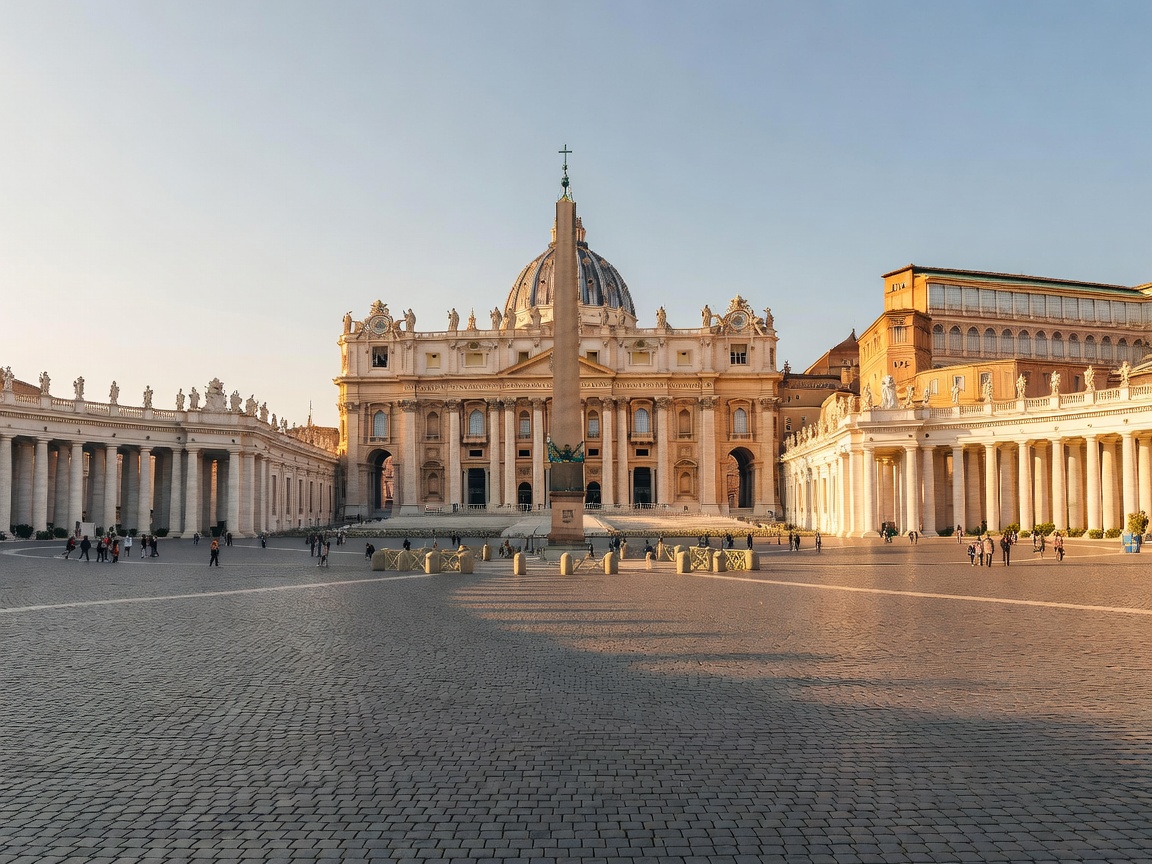
Physical Geography & Perimeter Demarcation
Vatican City State (Stato della Città del Vaticano) is the smallest sovereign nation on the planet, with an area of just 0.49 square kilometers (121 acres / 49 hectares). It is entirely situated on the Vatican Hill (Mons Vaticanus) on the west bank of the Tiber River, completely enclosed within the municipality of Rome, Italy.
The state's 3.2-kilometer border is delineated largely by ancient medieval and Renaissance defensive fortifications, notably the Leonine Walls erected by Pope Leo IV in the 9th century. In Saint Peter's Square, the international frontier is open to Italian municipal jurisdiction for public security and is marked on the ground only by a subtle curved line of white travertine stones spanning the outer perimeter of Bernini's colonnade.
Resolution of the "Roman Question" (Lateran Pacts)
Following the Capture of Rome by Italian troops in 1870, the extensive historical Papal States were annexed to the unified Kingdom of Italy. Popes subsequently retreated behind the Vatican walls, declaring themselves "Prisoners in the Vatican" and refusing to recognize the legitimacy of the Italian state—an impasse known to historians as the Roman Question (Questione Romana).
The diplomatic standoff was resolved on 11 February 1929 through the signing of the Lateran Treaty between the Holy See (represented by Cardinal Pietro Gasparri) and the Kingdom of Italy (represented by Prime Minister Benito Mussolini). The treaty established Vatican City as a sovereign, independent state, guaranteeing the Holy See complete temporal jurisdiction and international legal immunity.
Distinction Between Vatican City and the Holy See
In international law and diplomatic protocol, a critical distinction exists between Vatican City State and the Holy See (Sancta Sedes):
- Vatican City State: The physical territory, infrastructure, sovereign civil administration, gendarmerie, and postal system that serves as the territorial base.
- The Holy See: The supreme governing body of the worldwide Catholic Church and the recognized legal subject in international diplomacy. The Holy See—not Vatican City State—maintains diplomatic relations with over 180 countries, accredits ambassadors (nuncios), and holds Permanent Observer status at the United Nations.
Extraterritorial Properties Across Italy
Under the Lateran Treaty, the Holy See also exercises sovereign extraterritorial rights (similar to diplomatic embassy compounds) over 13 key religious, administrative, and historical properties scattered across Rome and Italy. These include the Major Patriarchal Basilicas of Saint John Lateran, Saint Mary Major, and Saint Paul Outside the Walls, the Papal Palace of Castel Gandolfo, and the Pontifical Urban University on the Janiculum Hill.